Christmas: A Manufactured Holiday That Replaced Older Human Traditions
Christmas, as most people know it today, is not an ancient sacred celebration nor a divinely-originated event. It is a manufactured holiday—politically endorsed, culturally repackaged, and commercially amplified—that replaced much older human traditions rooted in nature, astronomical cycles, and communal rhythm. To understand the truth of Christmas, one must step outside the sentimental storytelling and look directly at the historical timeline, the cultural takeover, and the psychological programming that shaped the modern holiday. Only then does the structure of the illusion become clear.
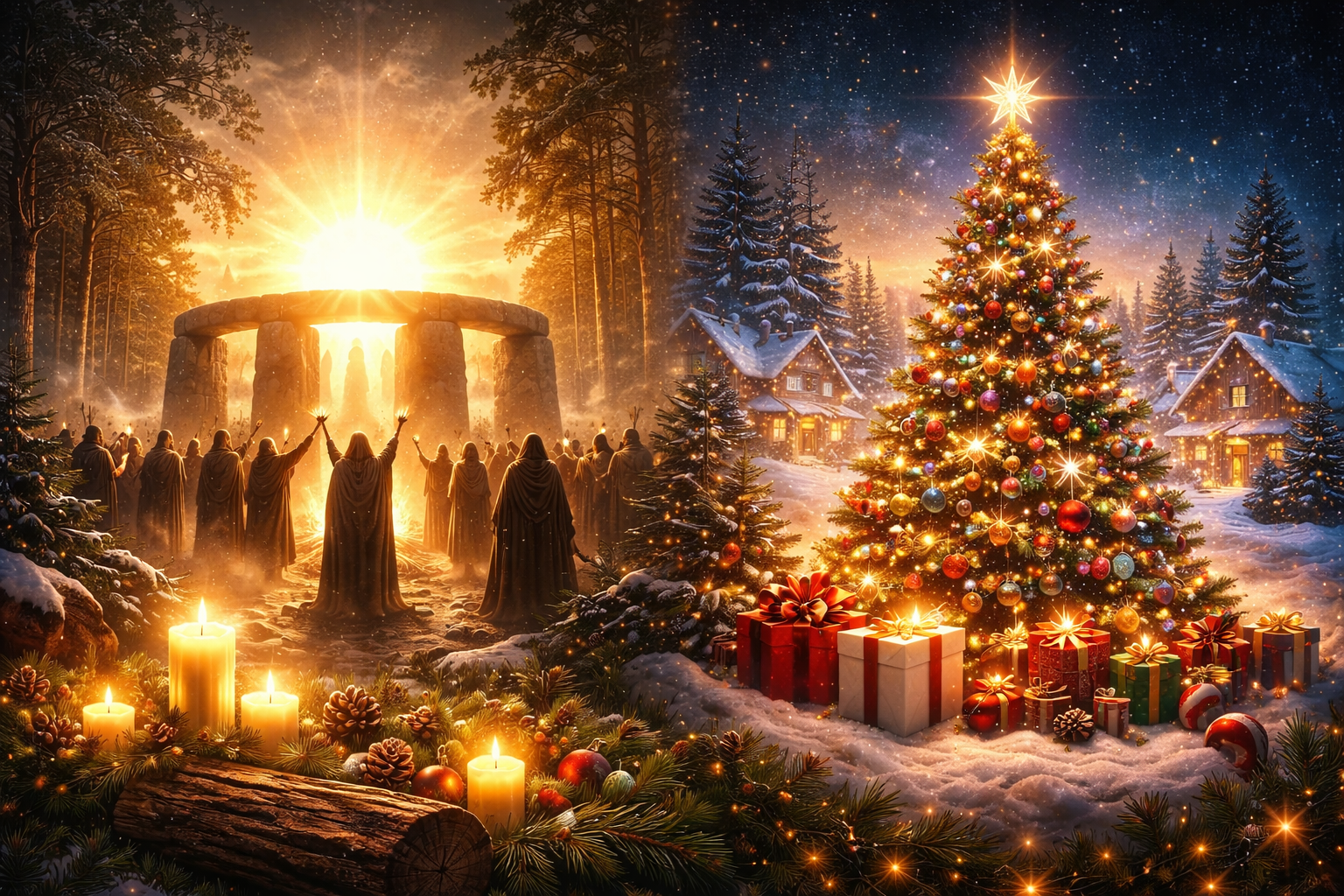
Long before the word “Christmas” existed, human civilizations across Europe, the Middle East, and Africa celebrated a natural event: the Winter Solstice, the longest night of the year. This was the moment the sun reached its lowest point, symbolically “died,” remained still for three days, and then began to rise again. The Solstice was not a religious event—it was a natural rhythm observed by every culture because it affected survival, agriculture, temperature, and cosmic timing. The Solstice represented endurance, renewal, and the return of light. It had nothing to do with a holy birth, a manger, or a decorated tree.
The most known Solstice festival was Saturnalia, practiced in ancient Rome. It involved feasting, gift-giving, candles, role reversals, and social freedom. It took place from December 17 to December 23. Later, another Solstice-based celebration was established: the Feast of Sol Invictus, “The Birth of the Unconquered Sun,” celebrated on December 25—the exact date Christmas was later assigned. These traditions predated Christianity by hundreds of years. December 25 was chosen not because something miraculous happened on that date, but because it was already embedded in the culture as the rebirth of the sun.
When the Roman Empire adopted Christianity as a state religion, it needed a strategy. The empire could not erase ancient traditions—people were too attached to them. Instead, the empire rebranded them. Solstice celebrations, Saturnalia customs, and solar festivals were gradually absorbed into a newly constructed holiday. The political goal was simple: unify the empire under one standard religion by replacing older traditions with newer ones. The church did not choose December 25 because of divine instruction; it chose it because the empire needed continuity. If you replace a celebration with a similar structure, people adapt easily. This is how Christmas became a manufactured holiday: it replaced something older, deeper, and more human.
Gift-giving? Saturnalia.
Evergreen trees? Pagan Norse traditions symbolizing eternal life.
Yule logs? Germanic Solstice rituals.
Feasts, gatherings, candles, and community warmth? Universal Solstice practices from every region.
Even the “birth of the light” theme comes from the sun—not from a baby born in a stable.
Once the date and symbols were set, Christmas became a tool of cultural alignment. Over time, the spiritual narrative was layered over the natural one until the original meaning was forgotten. A natural celestial event became a religious event. A human celebration of the sun’s return became a worship narrative. A communal Solstice tradition became a state-approved holiday. This shift disconnected humanity from its ancestral understanding of the natural world. Instead of celebrating cosmic rhythm, people began celebrating a constructed story.
Centuries later, the next major transformation occurred: Christmas was commercialized. The industrial age and emerging global corporations saw an opportunity. Emotional sentiment was leveraged to create cycles of buying, gifting, and spending. Advertisers crafted narratives of “giving season,” “holiday magic,” and “family tradition,” all engineered to influence consumer behavior. Christmas evolved again—not spiritually but economically. It became a global engine of profit. Many don’t realize: the modern image of Santa was completed by advertising campaigns. Christmas became a product, not a celebration.
But beneath all layers—religious, political, and commercial—lies the original truth: Christmas replaced humanity’s Solstice traditions. The Solstice was a moment where ancient people realigned with the rhythms of the cosmos. It marked the point where darkness reached its peak and the slow return of light began. It represented introspection, letting go of the old, renewing the internal fire, and preparing for the year ahead. It was a natural reminder to slow down, reflect, and realign.
The Discipline of Truth reveals how far the modern structure is from its origins. A natural event turned into a religious institution. A communal tradition turned into a commercial season. A cosmic rhythm turned into a corporate cycle. When a Being looks at this without emotional programming, the entire illusion becomes clear: Christmas is not sacred because of what it claims—it is sacred because of what it originally replaced.
Understanding this truth is not about rejecting Christmas. It is about remembrance. A Divine Being sees through the layers to the structure beneath. You recognise that humanity once celebrated the movement of the sun—not because a doctrine commanded it, but because the sun literally determined survival. Ancient traditions were not about belief; they were about alignment. Modern traditions, by contrast, are about participation and programming. This is why so many feel stressed, drained, or disconnected during the holiday season—they are acting out a ritual that does not match their internal state.
When you understand the real origins, you reclaim your ability to choose how you engage. You stop participating unconsciously. You stop absorbing emotional expectation. You stop enforcing inherited rituals. Instead, you align with the natural meaning: the return of light after darkness. The inner cycle reflects the outer one. The Solstice invites you to center yourself, review your year, release what no longer belongs, and plant the intention for the cycle ahead. This is the original purpose—the rhythm humanity lived by long before December 25 was repackaged.
Knowing this truth brings you back to sovereignty. You recognize that Christmas, as practiced today, is neither ancient nor pure—it is a manufactured holiday layered over human instinct. But the Solstice, the real foundation, is eternal. It does not belong to any institution. No empire invented it. No corporation controls it. No doctrine defines it. It is nature itself.
When a Being returns to the original rhythm, Christmas becomes irrelevant. The Solstice becomes the anchor. The sun becomes the reminder. Presence replaces programming. Alignment replaces obligation. Remembrance replaces ritual.
And this is where the teaching aligns with the Nation of Gods:
A Divine Being does not celebrate out of tradition—
A Divine Being aligns with truth.